Executive Summary↑
Today's research signals a shift from broad experimentation to vertical validation. We're seeing evidence that AI performs in high-stakes environments like classrooms and hospitals. A UK-based randomized controlled trial (RCT) confirms AI tutoring is safe and effective, which provides a roadmap for EdTech companies seeking institutional contracts. Moving past the "hallucination" panic toward measurable utility in specialized sectors seems increasingly likely based on these results.
Progress in robotics and autonomous agents remains steady but faces technical hurdles regarding data originality. The RoboMirror project demonstrates humanoids learning movement directly from video, a step toward more adaptable industrial robots. However, new data on 3D shape generation shows that models often memorize training data rather than creating original forms. This creates intellectual property risks for firms relying on generative design for proprietary products.
Investors should prioritize companies focused on verifiable outcomes in specialized markets rather than general-purpose tools. The real value is migrating toward models that can "act" in the physical world or solve specific industry bottlenecks with high precision. Training data quality remains the primary bottleneck for 3D and robotics applications.
Continue Reading:
- BOAD: Discovering Hierarchical Software Engineering Agents via Bandit ... — arXiv
- A Dataset and Benchmark for Consumer Healthcare Question Summarization — arXiv
- Memorization in 3D Shape Generation: An Empirical Study — arXiv
- AI tutoring can safely and effectively support students: An explorator... — arXiv
- RoboMirror: Understand Before You Imitate for Video to Humanoid Locomo... — arXiv
Technical Breakthroughs↑
Most software engineering agents today struggle with task delegation, often wasting compute by picking the wrong tool for the job. The BOAD framework uses bandit optimization to automatically discover the most efficient hierarchy for these agents. This approach treats agent selection as a mathematical problem rather than a guessing game. It should lower operational costs for firms building autonomous coders by ensuring they only use expensive "manager" models when strictly necessary.
The medical AI sector is also seeing a shift toward more specialized validation. A new benchmark for summarizing consumer healthcare questions addresses the fact that patients are often poor at describing their symptoms concisely. If a model can't strip away the fluff from a rambling patient query to find the core medical issue, it's a liability. Companies that prove their performance on this dataset will have a much easier time convincing hospital boards to adopt their technology.
Continue Reading:
- BOAD: Discovering Hierarchical Software Engineering Agents via Bandit ... — arXiv
- A Dataset and Benchmark for Consumer Healthcare Question Summarization — arXiv
Product Launches↑
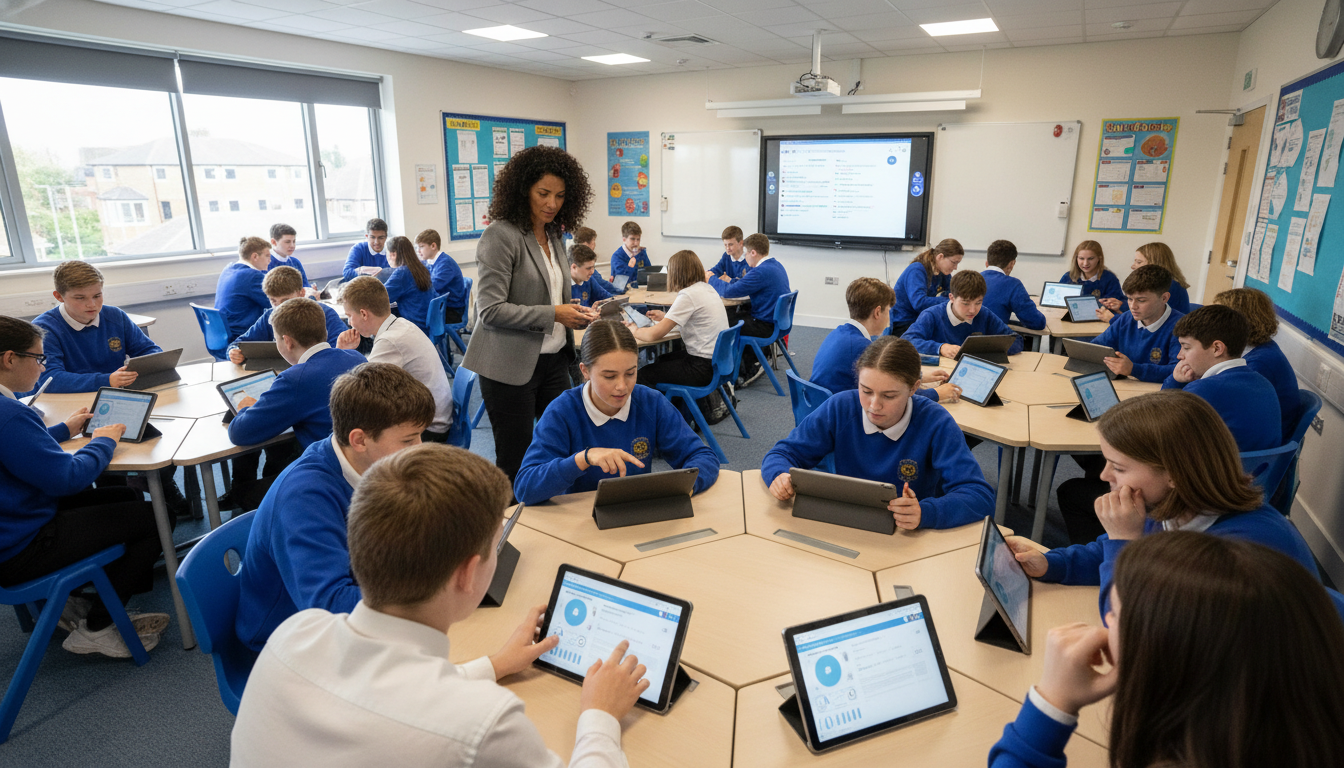
A new study on arXiv brings rare empirical weight to the EdTech sector by documenting an exploratory randomized controlled trial of AI tutoring in UK schools. Most startups in this space rely on anecdotal success, yet this research validates that AI can safely improve student performance within a regulated environment. This data provides a reality check for investors who've grown weary of "personalized learning" promises that rarely survive contact with actual teachers.
The focus on safety is the real takeaway. While the tech world obsesses over model benchmarks, school boards prioritize risk mitigation above all else. If these AI systems demonstrate consistent safety protocols alongside academic gains, we'll likely see a wave of procurement contracts that previously seemed stalled. The next hurdle is the unit economics of deployment, as these tools must prove they can outperform traditional workbooks without requiring a massive hardware refresh.
Continue Reading:
Research & Development↑
Generative AI for 3D objects often suffers from a lack of originality that threatens its commercial utility. A new study on memorization in 3D shape generation found that these models regularly regurgitate training data rather than synthesizing new forms. This matters for companies building spatial computing assets because unoriginal assets carry both legal risks and limited aesthetic variety. If the AI acts as a glorified search engine for 3D meshes, the value of the model drops for enterprise clients.
Humanoid robots have a persistent translation problem. The RoboMirror project suggests that robots should comprehend the mechanics of human movement before they try to copy it. This approach addresses the scaling bottleneck for firms like Tesla or Figure AI by making raw video a viable training source. We're entering a phase where the quality of this interpretation layer determines which hardware platforms actually survive in a commercial setting.
Continue Reading:
- Memorization in 3D Shape Generation: An Empirical Study — arXiv
- RoboMirror: Understand Before You Imitate for Video to Humanoid Locomo... — arXiv
Sources gathered by our internal agentic system. Article processed and written by Gemini 3.0 Pro (gemini-3-flash-preview).
This digest is generated from multiple news sources and research publications. Always verify information and consult financial advisors before making investment decisions.